Early
The system surfaces what the rep didn't notice. Cues arrive when the buyer's signal changes, not on a timer.
How it works
PitchGenius is an AI sales copilot with an Intelligence Loop. No bot joins your call. It runs as a transparent overlay on your own desktop, over Zoom, Teams, Meet or a phone call.
Six steps wrap each conversation. Understand and prepare come before it starts, observe runs while it happens, and validate, adjust and learn follow once it ends.
The Intelligence Loop
Learn does not end the cycle. What the Manager Coaching Report records goes back into the Buyer's Blueprint, which sets the objective of the next conversation and recalibrates the live coach before it starts, so each call opens on what the deal still has to learn.
See the Intelligence Loop →Powered by Live Buyer-State Intelligence™. PitchGenius listens continuously to the live conversation and interprets meaningful changes in buyer language, behavior and response. When it detects a buyer signal or objection that matters, it gives the seller two things immediately. It names the next best move and offers natural language the seller can use.
SIGNAL
Hesitation after the implementation timeline.
CONTEXT
Same hesitation appeared in the last two calls with this account.
EVIDENCE
Two competing initiatives named in discovery; no owner assigned.
MEANING
A capacity risk. The buyer doubts delivery.
NEXT MOVE
Name the capacity concern out loud before moving on.
Possible next best moves
Nothing meaningful happening? PitchGenius stays silent until the buyer's signal changes, so a cue on screen means the conversation gave the rep something to act on. That is what makes it feel less like software throwing prompts at you and more like an experienced coach beside you on the call.
See one cue with its five layers →Live discovery
When the team’s framework is MEDDPICC, which is the default, the overlay fills in its eight letters live. They are Metrics, Economic buyer, Decision criteria, Decision process, Paper process, Identify pain, Champion and Competition.
During the call
The overlay fills in each MEDDPICC letter live, so the rep sees what discovery has covered while the buyer is still on the line.
After the call
A MEDDPICC card on the deal marks each letter proved on the call, partly proved or not proved yet.
Human-first belief
Buyers don't want to be automated at. They want to be understood by someone who did the work. PitchGenius gives that person better eyes and leaves the conversation in their hands.
The AI observes. The human decides. That order never inverts.
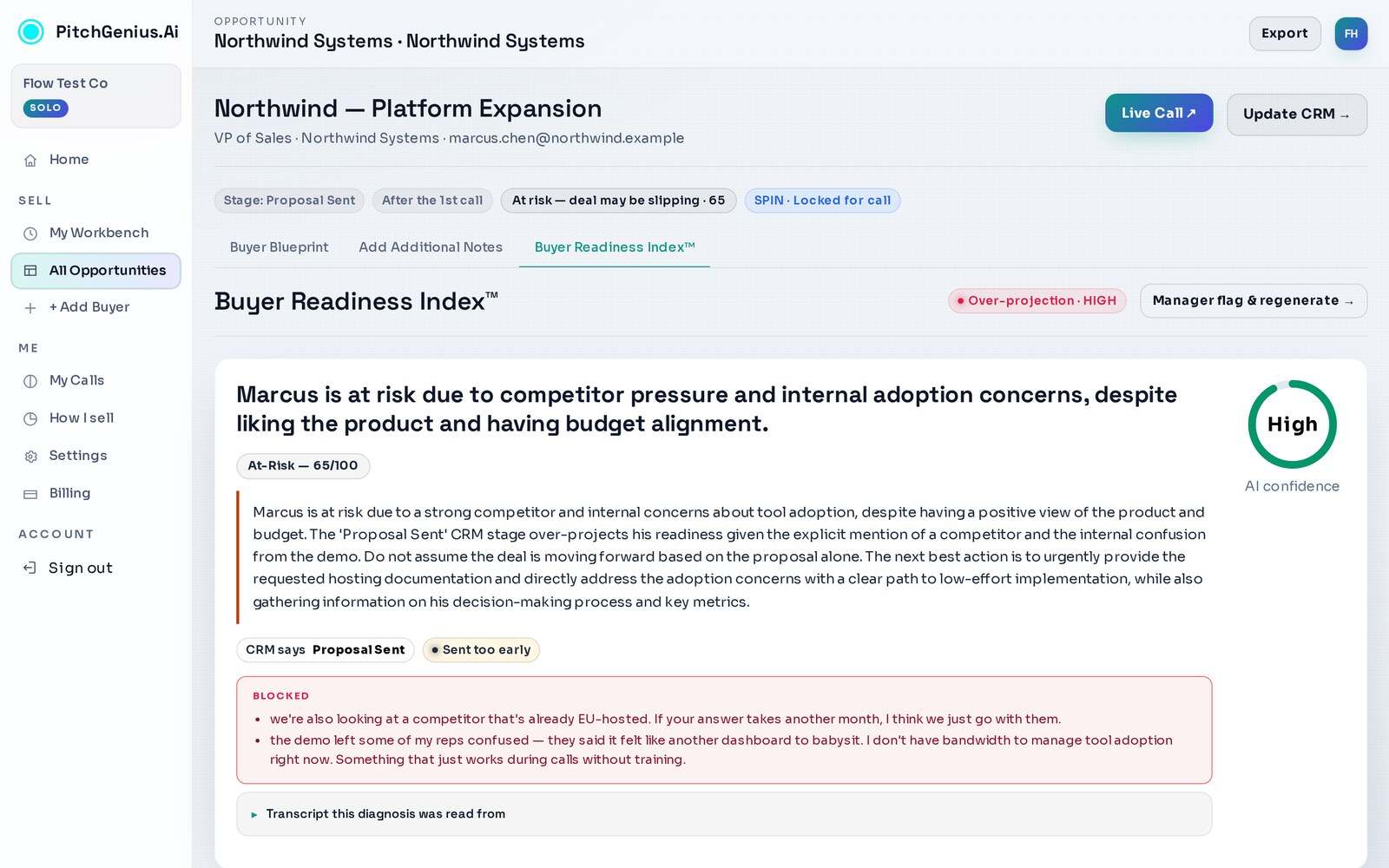
Five dimensions, each backed by something the buyer said or did, never by how the call felt.
Weak signal
"This looks great."
Stronger evidence
"I've asked legal to pre-review the MSA."
Weak signal
Champion attends every call.
Stronger evidence
Champion brings the CFO unprompted.
Weak signal
"Send me pricing."
Stronger evidence
"Here's the budget line we'd take it from."
What has this buyer actually done that a skeptic would accept? A dimension with no such words from the buyer is marked unproven.
See how the Buyer Readiness Index scores a call →03 Stage–readiness alignment →
CRM view
Buyer view
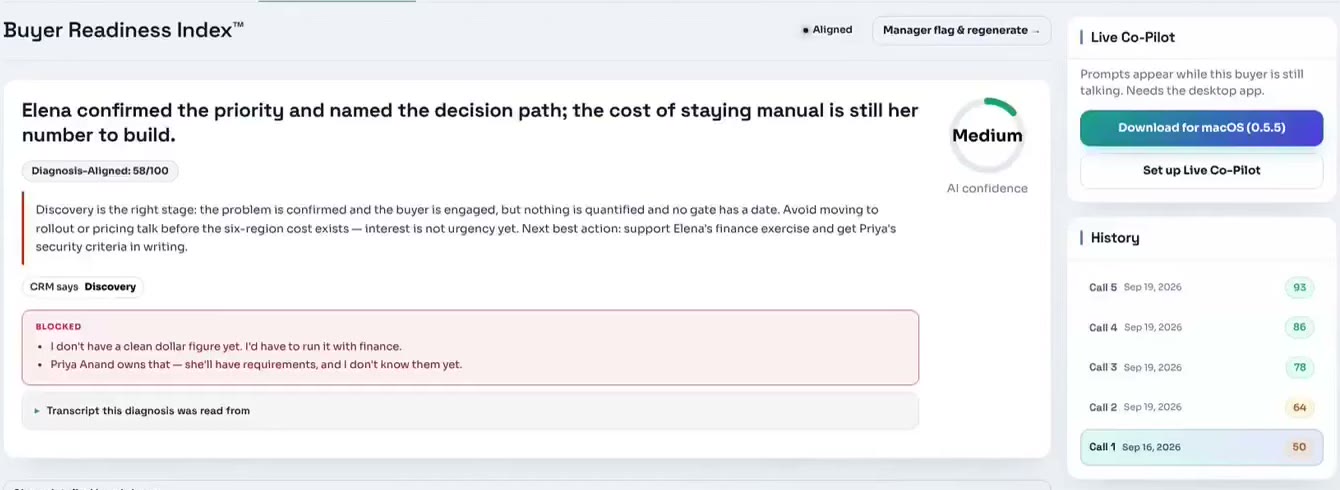
PitchGenius compares where the deal sits in your process against what the buyer has demonstrated. It flags the gap while there is still time to close it.
Misalignment is not a reporting problem. It's next quarter's miss, arriving early. Where the CRM stage and the readiness score disagree, review that deal first in the next pipeline meeting.
See how Stage–Readiness Alignment compares the two →04 Revenue leadership value
Every open opportunity carries one of three statuses, so pipeline reviews start where the risk actually is.
ALIGNED
Stage and buyer evidence agree. Let the rep run.
WATCH
Readiness is lagging the stage. One specific gap to close this week.
DIVERGED
The deal is being carried by activity alone. Inspect before the forecast call.
Which deals are moving because the buyer moved? Ask it in week three, not week twelve.
A short, evidence-backed read on what happened and the one thing worth coaching this week.
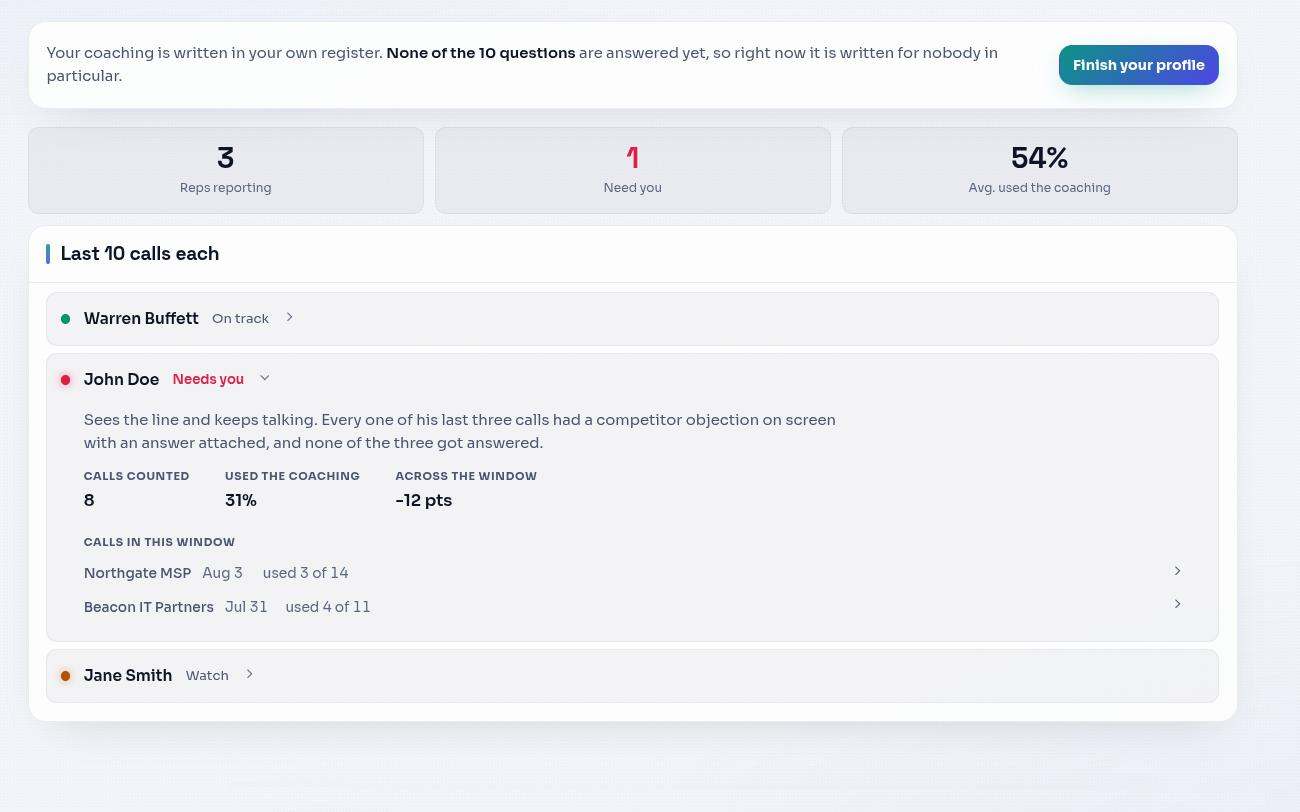
The buyer's language moved from timing to budget ownership.
Caught the budget signal and slowed down. Good instinct.
Never asked who else has to approve that line.
No cost of inaction was ever quantified out loud.
One skill. Convert a budget hint into an access request.
Rehearse the ask. Run it on Thursday's call. Review the clip.
Recurring patterns
Each rep's report names the pattern and the one skill to coach next, ready before the 1:1.
See the Manager Coaching Report →06 Rep development
PitchGenius is scaffolding. As judgment develops, the system steps back on purpose.
Early
The system surfaces what the rep didn't notice. Cues arrive when the buyer's signal changes, not on a timer.
Growing
The rep starts naming signals before the coach does.
Strong
The rep runs the conversation. The system steps back as follow-through rises.
What reps build
Watch the stage column. A rep who names signals before the coach does has moved from Early to Growing.
07 The compounding intelligence system
The loop closes. What the team learns on Tuesday shows up in Thursday's preparation.
Every call adds verified evidence to the account's buyer model.
Each blueprint starts from a better hypothesis than the last.
Live cues track which signals and qualification items the buyer has already given.
Every readiness dimension cites the quote behind it, so a score can be checked against the call.
Coaching follows recurring patterns from the calls.
Forecast confidence stops being a feeling and becomes a measurement.
Before the next call, open the Buyer's Blueprint. It is rebuilt from what the buyer proved on the last one, and your CRM keeps the deal record with readiness evidence added when connected.
See how the Buyer's Blueprint is built →Book a pilot