Strong looks like this
"I’ve asked legal to pre-review the MSA." That action would satisfy a skeptic.
Step 04 of 6 · Validate · Buyer Readiness Index™
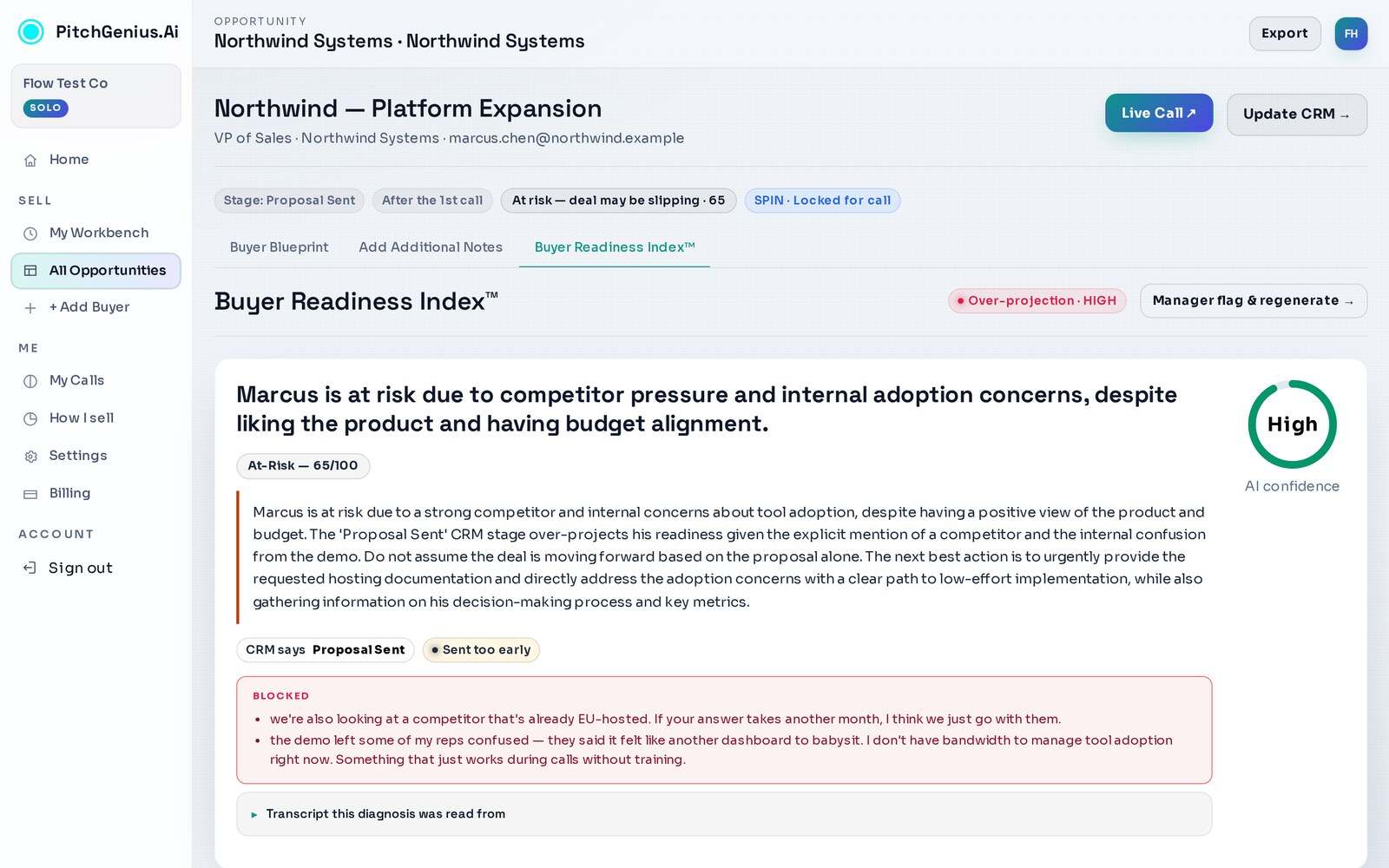
The Buyer Readiness Index™ is a post-call score of how ready a buyer is to move in a live sales call, not sales-rep readiness or mortgage pre-qualification. It rates five dimensions, Pain Recognition, Trust Formation, Problem Urgency, Solution Confidence and Commitment Behavior, each marked strong, weak or unproven from a verbatim quote.
It runs after the call ends, scoring what Live Buyer-State Intelligence watched during it. Stage–Readiness Alignment, next, compares that score against where the deal sits in the CRM.
The index, annotated
Each dimension carries the quote that earned its mark.
Sample data · Buyer Readiness Index™ · Daniel Mercer · Vanishlink
after today’s call
In practice
Readiness scores what this buyer did and said about this decision, and it makes no personality judgments.
"I’ve asked legal to pre-review the MSA." That action would satisfy a skeptic.
"This looks great." A compliment carries no evidence, so it does not score.
The dimension records the gap instead of guessing.
How it comes together
what was said and done
actions from the call
strong, weak or unproven, each with evidence
where this decision stands
Trust
STRONG FROM THE ACCOUNT
Champion brings the CFO unprompted.
Five dimensions from the call, Pain Recognition, Trust Formation, Problem Urgency, Solution Confidence and Commitment Behavior, each marked strong, weak or unproven.
An action a skeptic would accept, such as asking legal to pre-review the MSA, where a compliment like "this looks great" counts for nothing. Every dimension carries a verbatim quote from the transcript, and a quote that is not word for word from the call, or that another dimension already uses, is not accepted.
No. It scores what the buyer did and said on the call and never rates the buyer as a person. Readiness is based on what the buyer has done and what a skeptic would accept as evidence.
After every call, using evidence from that call.
Pain Recognition asks whether the buyer names the problem in their own words. Trust Formation asks whether the buyer shows you the real problem. Problem Urgency asks whether the problem needs action now. Solution Confidence asks whether the buyer believes the solution can produce the outcome they want. Commitment Behavior asks whether the buyer takes the next step the deal needs.
No. Pain Recognition and Trust Formation weigh the most, and the score drops hard only when one of those two is weak. A buyer with strong pain and trust but weak urgency and commitment still lands well past the early states.
The dimension is left out. A short call or one without real signal returns only the dimensions it can quote, from one to five, and never a repeated or invented quote.
In the sample deal, the buyer says "Honestly the ramp thing is fair. I'm on more calls than I was a year ago, not fewer." Pain Recognition scores strong on that quote. He also says "It's not on fire. It's just the thing I keep meaning to fix." Problem Urgency stays unproven, and the call lands in the stakeholder validation needed state with the unsigned stakeholder as the primary blocker.
PitchGenius reports readiness as one of nine states after each call: Unaware, Problem-aware, Diagnosis-aligned, Solution-curious, Solution-confident, Needs stakeholder validation, Commercially ready and Commit-ready, plus the cross-cutting At risk. A state is earned only from what the buyer demonstrated on the call, and Stage–Readiness Alignment then compares it with the CRM stage.
Stage–Readiness Alignment, the next step in the loopYes. After each call PitchGenius turns the transcript into a readiness score from 0 to 100, one of nine states, five dimensions each backed by a verbatim quote, and two blockers with the evidence and the next action. The Manager Coaching Report shows how a manager reads those calls across a rep’s week.
The Manager Coaching ReportSee it on a sample deal
The score lands after every call, from that call’s own transcript.
Keep exploring
Step 01 · Understand
A confidence-ranked brief on one buyer, short enough to read in the ninety seconds before the call.
Learn more about Pre-Call Buyer Intelligence™Step 02 · Prepare
A plan for how this call opens, built from your methodology and the pre-call evidence.
Learn more about Buyer's Blueprint™Step 03 · Observe
A quiet cue with its reasoning, shown only when the buyer's signal changes during the call.
Learn more about Live Buyer-State Intelligence™Step 04 · Validate
Five readiness dimensions scored after the call, each backed by something the buyer said or did.
You are here
Step 05 · Adjust
Where a deal sits in your CRM, set against what the buyer has proved.
Learn more about Stage–Readiness AlignmentStep 06 · Learn
A rep's week of calls reduced to the one skill to coach next.
Learn more about Manager Coaching Report™