
Pre-call
Buyer Readiness vs. Deal Stage: Why Your CRM Can Say “Late Stage” When the Buyer Isn’t Ready
A deal can advance through pipeline stages while buyer readiness falls, because the CRM records process events rather than the buyer’s decision.
Key takeaways
- 01A CRM stage records what the seller completed, so two Proposal-stage deals can look identical while one buyer has gone quiet.
- 02Forrester reports that 86% of B2B purchases stall during the buying process and that 13 people are involved in a buying decision on average.
- 03Each stage can carry buyer evidence as proof, such as the buyer confirming the budget exists and naming who signs before a deal counts as Proposal.
- 04Add one question to every late-stage review, the last buyer action with a date that shows the deal moving.
A deal can sit in the same CRM stage while the buyer's readiness rises or falls, so the stage alone cannot separate a real Proposal from a stalled one. The fix is to add a second column to the pipeline review, the last thing the buyer did.
Two deals sat in Proposal at the same Monday pipeline review. The first buyer had introduced procurement, confirmed the decision criteria in writing, and asked whether implementation could start before quarter close. The second buyer had accepted the proposal, gone quiet for eleven days, and answered my rep’s follow-up with "we'll circle back internally."
The CRM drew them identically, and the forecast weighted them identically. One of them was a real deal.
A deal can move forward in your pipeline while moving backward in the buyer’s mind. I ran mid-market teams for eight years. Every forecast miss I owned had the same shape. The stage was honest, the activity log was honest, and the buyer had left weeks earlier without telling anyone.
Forrester's buying research shows how much of a purchase happens outside the stage field. Most purchases stall along the way, and the decision belongs to a group.
| Measure | Forrester, 2024 |
|---|---|
| B2B purchases that stall during the buying process | 86% |
| People involved in a buying decision, on average | 13 |
| Purchases involving two or more departments | 89% |
Source: Forrester, The State Of Business Buying, 2024, published December 4, 2024, fetched October 1, 2026.
Method and limits: Forrester's press page states these figures without a sample size or method. They describe B2B purchases in general, not PitchGenius customers and not any CRM field.
What does a deal stage record?
A deal stage records what the seller completed. Discovery done, demo delivered, proposal sent and security review started are all events on the seller's calendar. Campaign Creators, a HubSpot partner, names the weakness in a guide to deal stages: "Activity-based stages measure sales effort rather than buyer commitment" (Campaign Creators, Deal Stages That Leaders Trust, March 18, 2026, fetched October 1, 2026).
Its examples are the ones every pipeline carries. A scheduled meeting shows a conversation will happen, a completed demo shows the product received attention, and a delivered proposal shows pricing reached the prospect. None of the three shows the buyer intends to buy.
What does buyer readiness record?
Buyer readiness records the buyer's side of the same moment. It covers trust, perceived risk, urgency, confidence in the solution and whether anyone inside the company will argue for the deal when you are not in the room.
Salesforce has no field for those conditions. A stage can read Proposal while the buyer thinks "I'm interested. I'm not taking this internal yet." The database sees progress, and the rep needs to see the hesitation.
Intentsify, an intent-data vendor, draws the same line from the marketing side. Research stages come from third-party intent data, and buying stages come from your own CRM and logged interactions. Its warning applies to any single source: intent signals "should not be used on their own to predict an account’s propensity to buy" (Intentsify, research stages and buying stages, fetched October 1, 2026). A call transcript adds the one source neither system holds, which is what the buyer said.
How do you fix the stage field?
Campaign Creators proposes that every stage carry three parts: an objective, a decision proof and an owner. The decision proof is the evidence that confirms the buyer reached the milestone, and its examples are a problem acknowledged by a decision maker, a confirmed budget and a documented buying process.
A call quote can serve as the proof for each of those. The table pairs each stage with the buyer's words a rep could paste into the CRM note.
| Stage | Event that moves it today | Buyer evidence that proves it | Source |
|---|---|---|---|
| Discovery | Discovery call completed | The buyer names the problem and what it costs, in their own words | Decision proof examples |
| Solution fit | Demo delivered | The buyer says what the solution would have to do for the problem to count as solved | Decision proof examples |
| Proposal | Proposal sent | The buyer confirms the budget exists and names who signs | Decision proof examples |
| Verbal commit | Verbal yes received | The buyer states the buying process, the dates and the paperwork | Decision proof examples |
Source: the decision proof categories come from Campaign Creators, fetched October 1, 2026. The stage names follow its list of common B2B stages, and the buyer-evidence wording is ours.
Method and limits: Campaign Creators does not publish this table, and your pipeline may use different stage names.
The pairing turns the stage into a claim a rep must back with a quote. A Proposal with no budget statement from the buyer is a document that was sent.
What does the gap look like on a real screen?
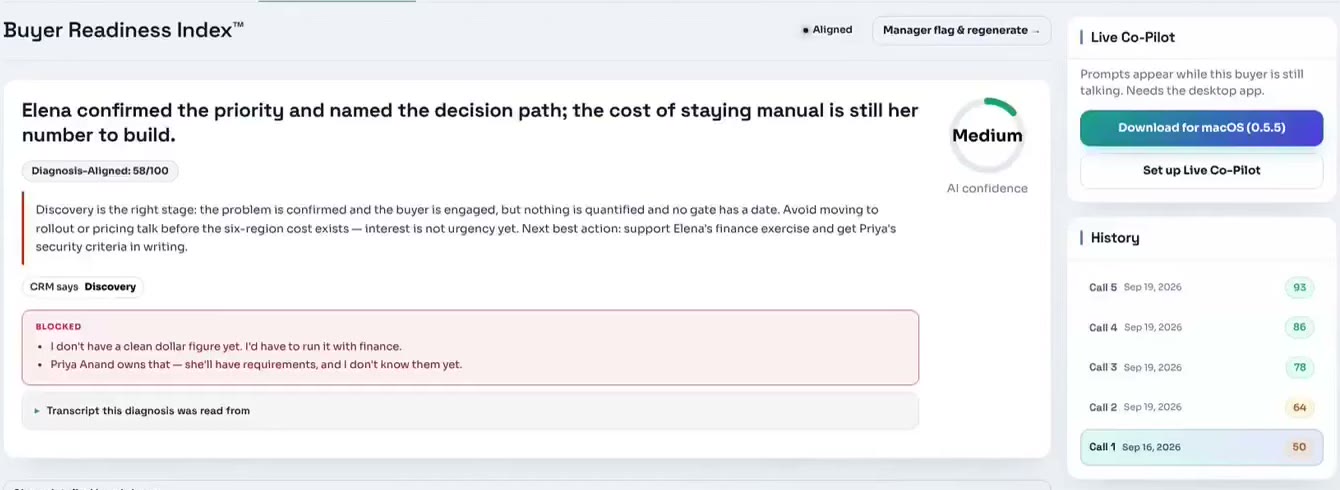
Source: PitchGenius product demo, chapter 5, the first frame of the recording, cropped from the 1920 by 1080 capture to 1340 by 490 pixels.
Method and limits: sample data, no customer result.
The CRM line and the diagnosis sit on the same card. The stage reads Discovery, the diagnosis says nothing is quantified and no gate has a date, and the next best action is to support the buyer's finance exercise before any rollout talk. A stage field alone would show a deal that looks quiet.
Why does the buyer change before the CRM does?
Language changes first. Future tense goes conditional, so "when we roll this out" becomes "if we were to do something like this". Specific implementation questions turn vague. The enthusiastic buyer starts talking like a messenger relaying your pitch upstairs, and next steps get harder to book. Those changes leave the stage field untouched while they change the probability that the deal advances. Seven signals in how a buyer talks lists them with the call moment to listen for.
Is interest the same as readiness?
"They loved it." Every rep has said it after a great meeting, and every manager has watched a loved-it deal evaporate three weeks later. The seller measured enthusiasm, and the purchase required enough confidence to accept the perceived risk of change.
A buyer can like your product, understand the ROI, believe your deck and enjoy working with you while lacking the readiness to move. Liking you carries less commitment than betting their reputation on you.
How should a pipeline review change?
Add one question to every late-stage deal in the review: what is the last buyer action, with a date, that shows this deal moving? Look for open concerns, a reason to act now, the direction of perceived risk and an advocate who will support the solution when you are out of the room. Separate actions the buyer took from actions the buyer said they would take.
Stage–Readiness Alignment runs that check next to the stage, and the Buyer Readiness Index™ puts a quote under each dimension of it. What a Buyer Readiness Index is explains the five dimensions and how to test the score on your own won and lost deals.
Where does AI help with this?
The evidence lives in meetings, live conversations, email language, CRM history and stakeholder behavior, and manual fields cannot hold all of it. An AI that reads across the sources can surface what changed, why it matters and what to do next. The useful score is the explained one, so a rep can argue with it.
Does readiness replace the stage?
CRM stages stay necessary. Organizations need a standardized pipeline process, and without one every rep tracks deals their own way.
The working model uses both views. The stage tells leadership where the deal is supposed to be, and readiness tells you where the buyer is. When the two disagree, that deal needs a closer look.
At your next forecast review, take the two deals you weight highest and ask for the last buyer action, with a date, that shows each one moving. A deal with no such action is sitting in its stage and waiting.
Watch the demo to follow one deal through every call.
Frequently asked questions
What is buyer readiness in sales?
The buyer’s current willingness and confidence to take the next meaningful step toward a purchase, shown by what the buyer says and does on calls.
Is buyer readiness the same as buyer intent?
No. Intent covers interest and behavioral signals that a purchase is possible. Readiness asks whether the buyer is prepared to act, and it comes from the buyer's own words in the conversation.
Why can a late-stage deal still be at risk?
Stages measure completed activities. They do not capture trust, perceived risk, internal consensus or willingness to proceed, and late-stage deals fail on those conditions.
Can AI measure buyer readiness?
AI can analyze the evidence associated with readiness, including conversational behavior, commitments, objections, language shifts and deal history. Treat the output as decision support with the quotes attached.
What is the Buyer Readiness Index?
PitchGenius AI's Buyer Readiness Index™ translates buyer and deal signals into a view of whether the buyer is ready to advance, with the evidence shown beside the number.