
Discovery
The Buyer Changed Before the CRM Did: 7 Sales Signals That Can Change a Deal
Seven conversation signals can reveal a buyer changing in seconds, long before someone records an event in the CRM.
Key takeaways
- 01Seven shifts in how a buyer talks show a deal moving before the CRM records an event, and each one is a change against that buyer's own earlier calls.
- 02Conditional future language, vaguer questions and a decision-maker who turns into a messenger are among the shifts to listen for.
- 03An objection that goes quiet is more dangerous than an explicit one, because an objection you can hear is a problem you can solve.
- 04A single phrase proves nothing and the pattern across calls carries the information, so live recognition gives the rep time to respond during the call.
Seven shifts in how a buyer talks show a deal moving before the CRM records an event. Each one is a change against that buyer's own earlier calls, and that comparison is what the standard buying signal lists leave out.
Sales teams are trained to watch the pipeline. Watching the buyer gives an earlier view because a CRM changes after someone records an event while a buyer can change in seconds.
I have lost deals where the CRM showed nothing wrong until the end. The stage history was a flat line of progress. The real story sat in call recordings, buyer word choices, and scheduling emails nobody reread. The deal did not die suddenly. It moved quietly for weeks before the field updated.
What are buying signals?
Buying signals are verbal, behavioral or data-driven cues that a prospect is interested or ready to move. DealHub's glossary defines them as cues "that indicate a prospect’s interest or readiness to make a purchase" and sorts them into four types, verbal, nonverbal, digital and data-driven (DealHub, What are Buying Signals, fetched October 1, 2026).
Momentum lists seven common ones, each with an example question and a strength rating. Asking for pricing and terms sits at the top, rated high, and requesting a tailored demo or a case study follows (Momentum, buying signals, fetched October 1, 2026).
Those lists describe a buyer who is warming up. A buyer also cools, and the cooling shows in the same call as a change in how they talk. The seven shifts below cover the change in both directions, and each one needs the buyer's earlier calls to read.
These seven come from our own observation of how buyers talk in deals and are not the result of a study, and no count of calls sits behind them, so check each against your own recordings.
Buyers also form a view before any rep records anything. In 6sense's 2025 survey of more than 4,000 buyers, most buying groups had already picked a favorite before first contact.
| Measure | 6sense, 2025 |
|---|---|
| Buying groups that ranked preferred vendors before first contact | 94% |
| Purchases made from that preliminary favorite | 77% |
Source: 6sense, The Timeline for Influencing B2B Buyers Is Shrinking, published November 12, 2025, fetched September 30, 2026.
Method and limits: 6sense reports responses from more than 4,000 buyers across North America, EMEA and APAC. These are reported shares, and they do not show that a preliminary favorite wins because it was ranked first.
1. Future language becomes conditional
Earlier, the buyer says "When we roll this out…"
Later, the buyer says "If we were to do something like this…"
One word flips it. The buyer's certainty has weakened, and disengagement is unproven. Closing harder is the wrong response, so ask what changed.
2. Questions become less specific
Ready buyers ask practical questions such as "How would implementation work?" "Who needs to be involved?" "What happens during onboarding?" and "Can the system support this workflow?"
When questions drift from concrete execution toward vague curiosity, readiness is moving. Momentum lists implementation questions as a buying signal, and the same questions turning vague is the cooling version. The signal comes from the change against that buyer’s previous baseline.
3. A decision-maker becomes a messenger
This shift is easy to miss in complex B2B sales: the person across the table stops speaking as the person deciding and starts speaking as the person carrying your message to someone else.
"We'll have to see what leadership thinks." "I need to take this back." "They'll probably want to understand the ROI."
Gong's research on executive deals puts the size of the room behind the messenger: "A won $50K–$250K deal these days typically involves at least 10 stakeholders" (Gong, When and how to multi-thread when selling to executives, published February 13, 2026, fetched October 1, 2026). Your contact is one of ten voices, and the messenger shift tells you which of the other nine you have not met.
When it happens, your job changes on the spot. You are arming the person in front of you for a conversation you will not attend. A rep who keeps selling to the messenger leaves nothing that lands two levels up.
4. Objections become less explicit
A clear objection gives the rep something to work with. "This feels too expensive." "We don't have implementation resources." "Legal won't approve that." Each statement gives the rep something concrete to explore and price.
More dangerous language sounds harmless. "Interesting." "Good to know." "We'll think about it." "Send that over." The buyer remains polite while the real concern disappears from view. An objection you can hear is a problem you can solve, and one that goes underground quietly kills a deal.
5. Scheduling resistance increases
A buyer who was easy to book suddenly will not commit.
"Let's get procurement on Tuesday."
"Send me something and we'll find time."
The second sentence carries information about commitment as well as scheduling. The deal is alive, and the calendar shows what politeness hides. DealHub counts "quick calendar acceptance" among the positive signals, so slow acceptance from a buyer who used to accept fast is its mirror.
6. Risk questions increase
As a purchase becomes real, buyers think harder about what could go wrong. Their concerns involve security, implementation, adoption, integration, internal change and contract terms.
A run of deeper risk questions is a positive signal. The buyer has started mentally owning the decision, and has moved from "is this interesting?" to "what happens if I do this?" Treating every concern as resistance creates a second mistake. Watch the direction of the anxiety, since the existence of it proves nothing.
7. The buyer stops correcting you
This signal is easy to read as agreement. During healthy discovery, an invested buyer will correct you with "Not exactly. The real issue is…" They care enough to make sure you understand.
At one meeting, you get something wrong, and the buyer just says "Sure."
Agreement does not establish alignment. When a buyer stops correcting you, they may have stopped expecting to be understood, which is worth a direct question.
How do you track buying signals during a call?
Write each signal as a quote with the call it came from, then compare it with the same buyer's earlier calls. A single phrase proves nothing, because human communication is noisy. The pattern carries the information: what came before, what changed, when the change occurred, and whether other signals moved with it after the pricing conversation, the security review or the new stakeholder.
Simple sentiment scoring fails on complex B2B conversations because "was the buyer positive or negative?" misses the question that matters. The useful analysis names what changed in the buyer's willingness, trust or perceived risk and records the evidence for that reading.
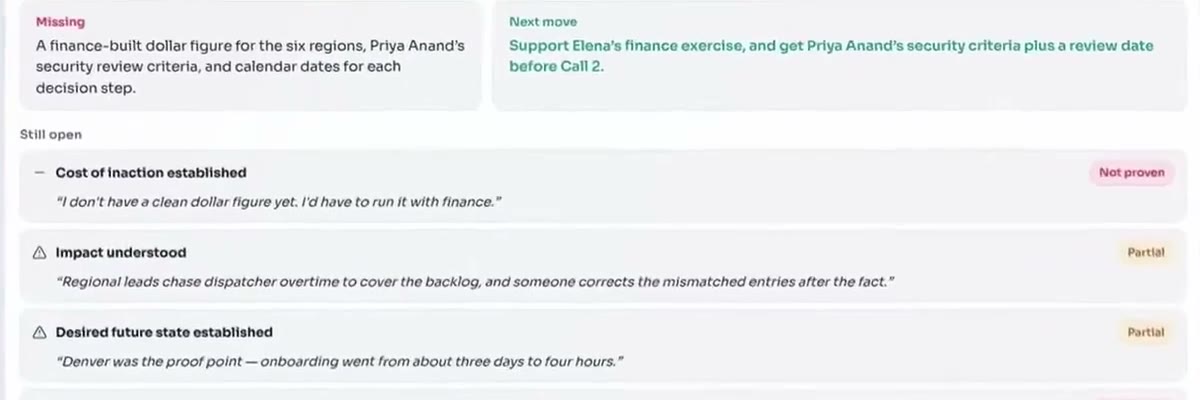
Source: PitchGenius product demo, chapter 4, the frame at 22 seconds of the recording, cropped from the 1920 by 1080 capture to 1200 by 400 pixels.
Method and limits: sample data, no customer result.
The frame shows the format worth copying even without the tool: a signal, the milestone it touches, and the buyer's exact words. The quote with a Not proven mark says the cost of doing nothing has no number yet, which is a signal about the deal and carries no sentiment.
Why does live recognition matter?
Post-call analysis teaches the next conversation. Live recognition gives the rep time to respond to today’s shift.
If the buyer moves during the meeting, the rep can slow down, stop explaining, pursue the objection that went underground, ask for the next step, or hold silence and let the buyer fill it. An hour after the call, those options are gone.
Live Buyer-State Intelligence was built to help the rep notice sooner and respond while the conversation is still active. Buyer readiness versus deal stage shows what the same shifts do to a deal the CRM still calls late stage, and real-time coaching without cognitive overload explains why a live cue shows one of them at a time.
Before your next pipeline review, take the three deals you would defend hardest and write down the last thing each buyer said that sounded different from a month ago. A deal where you cannot name one is a deal you are reading through the CRM.
Watch the demo to follow one deal through every call.
Frequently asked questions
What are buyer signals?
Observable behaviors or statements that provide evidence about a buyer's interest, risk, commitment, readiness or intent. A signal carries more weight when the same buyer's earlier calls show the change.
What is a buying signal?
Evidence that a prospect is moving closer to a purchase or a next step, such as questions about pricing, implementation or contract terms. A buyer also gives cooling signals when those questions turn vague.
Are objections negative buying signals?
Not necessarily. Some objections surface precisely because a buyer is seriously evaluating the decision, and silence is the worse signal.
Can AI detect buyer signals during calls?
AI can detect linguistic and conversational patterns associated with changing sales conditions. The person who knows the deal should interpret those signals in context, with the buyer's quote beside each one.