
Pre-call
Reps Forget Discovery Questions: A Call-Prep Checklist
Reps forget discovery questions because the list lives in their head. Six prep steps that put the right questions in front of the rep, and the ones PitchGenius writes for them.
Key takeaways
- 01A rep forgets discovery questions when the list exists only as a memory of what a good call sounds like.
- 02Working-memory research puts the central limit at about four chunks, so a rep cannot hold the buyer's words, the plan and the next question at once.
- 03A six-step prep routine ends in a one-page plan with questions written for this buyer and a short list of facts you do not have yet.
- 04The call moves faster than a written list, which is the gap a live prompt fills.
A rep forgets discovery questions when the list exists only as a memory of what a good call sounds like. The fix is a one-page prep routine that ends with questions written for this buyer and a short list of facts you do not have yet, so the call has somewhere to go when the buyer says something unexpected.
The six steps below work with a notebook. After each one, the page says what PitchGenius's pre-call screen writes for the same step, so you can see the routine and then decide whether to hand it to a tool.
Why do reps forget discovery questions?
Two causes stack. The first is memory. Mid-call, a rep holds the buyer's words, the plan and the next question at once, and the research on working memory puts the central limit at about four chunks (Cowan, 2001, abstract fetched October 1, 2026). Real-time coaching without cognitive overload counts the items a rep tracks and compares them with that limit.
The second is the list itself. Highspot's FAQ answers how reps should prepare with research on the company, role and recent initiatives, then "thoughtful questions that explore goals, challenges, and decision criteria" (Highspot, discovery call guide, fetched October 1, 2026). A general list of that kind tells a rep what to ask in any call. The call in front of the rep needs the three or four questions this buyer has not answered yet.
How do you prepare a call so the questions are there?
- Collect what you know about the buyer, and keep the source.
- List what you do not know, as questions.
- Match the approach to the buyer.
- Write the opening and the next question for each stage the call might reach.
- Write down what this buyer trusts and what makes them pull back.
- Choose the one fact you must leave the call with.
Steps one and two build the known and unknown parts by hand. Pre-Call Buyer Intelligence, a confidence-ranked brief, adds a likely level between them.
Step 1. Collect what you know, and keep the source
Write down the buyer's name, role, company and any notes from earlier contact. Keep the link next to each fact, so you can tell a verified fact from an assumption on the call.
In PitchGenius, a rep types whatever they have, a name and company, an email, a LinkedIn URL or pasted text. PitchGenius searches public sources for that buyer and keeps the source URLs with the profile. It holds back identity details unless two independent sources, or a LinkedIn URL, back them up. The product demo walks one buyer through this screen.
Step 2. List what you do not know, as questions
Write two to five questions that would close the largest gaps in what you know. PitchGenius's pre-call step words its unknowns as questions such as "Team size?" and "Who else has to agree?". Each names a hole and assumes no fact.
The pre-call script includes two to five questions about what the buyer record does not contain, so a gap becomes a question for the rep to ask.
Step 3. Match the approach to the buyer
Decide whether this buyer needs questions that uncover a problem, a message that challenges how they see it, or a low-pressure sequence that lowers their guard. The glossary covers SPIN, NEPQ and the Challenger Sale if you need the differences, and the comparison of all four methods says which buyer sentence points to which.
PitchGenius selects one of four, SPIN, NEPQ, Challenger or a hybrid, and scores each. When the evidence is thin, it steers toward the hybrid instead of a confident single pick.
Step 4. Write the question for each stage the call might reach
Write two or three open questions for each place the buyer could be when the call starts, from not yet aware of the problem to ready to buy, and skip the single script. Prepare for the stage the buyer actually shows up in. Avoma's playbook gives sample questions for each method, such as the SPIN implication question "How do these challenges affect your team’s productivity?" (Avoma, discovery call playbook, fetched October 1, 2026).
PitchGenius writes 3 to 5 open questions for each of nine readiness states, phrased for this buyer's role, known pain and industry, and its pre-call prompt drops any question that fits any buyer. A VP of Revenue Operations gets different questions from a founder.
Step 5. Write down trust triggers and resistance signals
Note two or three things this buyer has reacted well to, and two or three that make them pull back.
PitchGenius produces three to five of each per buyer, alongside a DISC profile, an OCEAN profile and an evidence-confidence level that decides whether the read is only suggested, recommended or locked.
Step 6. Choose the one fact to leave with
Pick a single thing you must know or agree to by the end, for example who else has to agree. Write it at the top of the page. When the call drifts, it is the question to go back to.
What does the milestone list look like on a real screen?
PitchGenius turns the call objective into ten milestones the call has to prove, each written for the buyer.
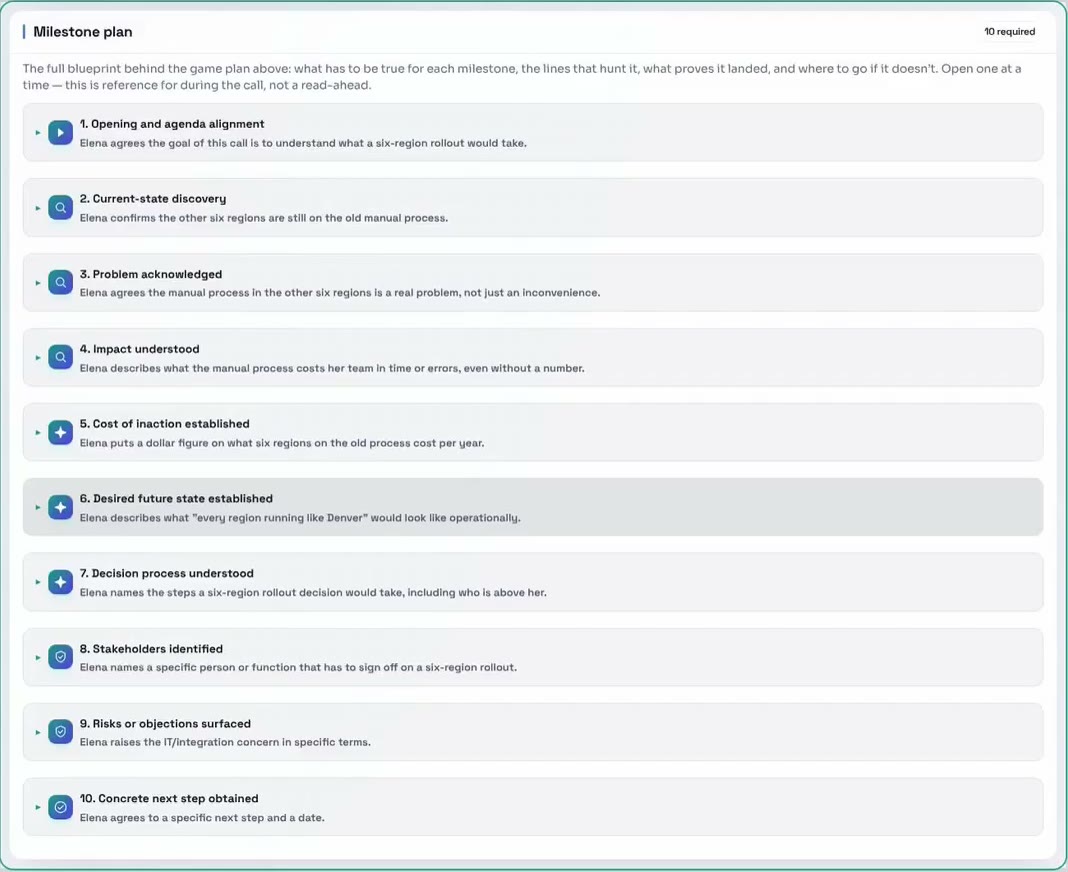
Source: PitchGenius product demo, chapter 3, the frame at 20 seconds of the recording, cropped from the 1920 by 1080 capture to 1068 by 872 pixels.
Method and limits: sample data, no customer result.
Each milestone doubles as a question. Cost of inaction established, written for this buyer, reads "Elena puts a dollar figure on what six regions on the old process cost per year." A rep with that line on the page knows what to ask when the buyer describes the problem and never names a number.
What does a pocket card for any call look like?
The milestone names carry over to any deal. Here is the version for a notebook, with a first question for each.
| Milestone | What the buyer must say or do | First question to ask |
|---|---|---|
| Opening and agenda alignment | Agree the goal of the call | "Here is what I planned to cover. What should we add?" |
| Current-state discovery | Describe how the work runs today | "Walk me through how this happens in a normal week." |
| Impact understood | Say what the problem costs in time or errors | "What happens downstream when that goes wrong?" |
| Cost of inaction established | Put a figure on doing nothing | "If this stays as it is for a year, what does that cost?" |
| Decision process understood | Name the steps and who sits above them | "How does a purchase like this get approved here?" |
| Stakeholders identified | Name who has to sign off | "Who else will want a say before this moves?" |
| Concrete next step obtained | Agree a specific step and a date | "What should happen before we speak next, and by when?" |
Source: the milestone names come from the Milestone plan frame in the PitchGenius product demo, chapter 3. The questions are our own wording, written to match the milestone descriptions in that frame.
Method and limits: this card is a notebook version and PitchGenius does not generate these exact lines. The seven rows are a subset of the ten milestones, chosen because every discovery call needs them.
What does the finished page look like?
- Buyer, role and source links.
- Unknowns, two to five, written as questions.
- Approach, with one sentence on why.
- Two or three open questions for each stage the buyer might be in.
- Trust triggers and resistance signals.
- The one fact to leave with.
The list has to fit on one page, because a longer one will not get read mid-call.
Why do good reps still forget?
The call moves faster than a written list. A buyer says something, the rep follows it, and the planned question is gone. That is the gap a live prompt fills. PitchGenius's desktop overlay shows one suggestion at a time, with a disclosure for the reason, and stays quiet when a moment calls for nothing. The pre-call plan and the live cue share the same milestone list, and seven signals in how a buyer talks lists what to listen for between the questions.
Frequently asked questions
Why do reps forget discovery questions?
The questions are remembered as a general feel for a good call and stay unwritten for the buyer in front of them. A short, buyer-specific list prepared before the call fixes that, since working memory holds only about four chunks.
How many discovery questions should a rep prepare?
Enough to cover each stage the buyer could be in, and no more than fits on one page. PitchGenius writes 3 to 5 per readiness state and 2 to 5 unknowns.
What is an unknown in call prep?
It is something your record does not carry, written as the question that closes the gap, such as team size or who else has to agree.
Does PitchGenius write the questions for me?
Yes, in its pre-call step, from what you enter about the buyer. Where the record has a gap, the script lists it as a question to ask.
Can I run this without a tool?
Yes. The six steps work in a notebook. The tool saves time and keeps the source with each fact.