
Comparison
Gong vs. Live AI Sales Copilots: The Difference Explained
Gong provides conversation intelligence and organizational memory, while live copilots support the rep during a call that is still winnable.
Key takeaways
- 01Gong's core job is organizational memory built from recorded calls, and Gong also describes real-time signals inside its broader offering.
- 02A live copilot works the window that call review cannot reach, the part of the active conversation the rep can still change.
- 03The two categories are converging, with Outreach describing Kaia as real-time enablement plus post-call functionality and Revenue.io pushing prompts during active calls.
- 04Buy Gong for large-scale call capture and historical analysis, and evaluate live copilots for how the rep reads the buyer and decides while the call is still happening.
Gong and live AI copilots solve different jobs: Gong's core is organizational memory built from recorded calls, and it also describes real-time signals, while live decision support gives the rep a line during a call that is still winnable.
Comparisons begin by judging Gong as good or bad. That framing misses the job each product is meant to solve.
Gong is an established revenue-intelligence platform with automatic recording, transcription, conversation analysis, deal signals, CRM automation, and AI assistants. I have seen its coaching workflows work inside real teams.
The useful decision starts with the job you are trying to solve. Conversation intelligence and live decision support address different problems. Buying the wrong one is expensive in licenses and in a year of muscle memory.
PitchGenius is built around a third idea. It keeps one Buyer's Blueprint per deal, so what the last call proved is already in place when the next one opens. The pre-call brief starts the Blueprint, the live coach tests it, and the post-call analysis rewrites it. That cycle is the Intelligence Loop.
What did conversation intelligence solve?
Ten years ago, the biggest problem in sales management was ignorance at scale. Leadership had no reliable picture of what happened across hundreds of customer conversations. There was little to review, search, or use for coaching.
Conversation intelligence addressed that gap. Teams can record calls, transcribe them, search them, pull themes, review objection handling, inspect deals, and support coaching with evidence instead of anecdotes. Gong’s manager materials still center on captured calls, scorecards, and data-backed coaching.
That creates organizational memory. It gives the whole company a record of what happened in its conversations.
What job does a copilot do instead?
A live AI sales copilot focuses on the window conversation intelligence cannot reach. It supports what the salesperson can still do inside the active conversation.
The buyer says "I'm not sure our team is ready for another change."
An analysis platform makes that moment searchable and coachable later. A live decision-support system tries to interpret it now with a cue such as possible adoption-risk signal; explore what changed before presenting another benefit.
One provides memory and the other supports execution. Both are valuable. Confusing them can leave a team with a post-call library and no change in what happens on calls.
The market is converging, so ask sharper questions
This distinction is getting less binary by the quarter. Outreach describes Kaia as combining real-time enablement with post-call functionality. Revenue.io pushes prompts during active calls. Gong describes real-time deal and buying signals inside its broader offering, while its core coaching workflows remain anchored to captured conversations and review.
What each product says about itself shows how close the two have come. These are the vendors' own sentences as of October 1, 2026.
| Product | Live help for the rep | In the vendor's words | Price shown |
|---|---|---|---|
| PitchGenius | Yes | A buyer profile before the call and one suggestion at a time during it, silent when nothing is worth saying | Solo at $299 a month with a 7-day trial, or $3,289 a year |
| Gong | No line for the rep | "Insights are surfaced in real time" flagging risks, next steps and coaching opportunities | None, "Licenses are priced per user" plus a platform fee, behind a form |
| Outreach | Yes | Kaia joins live meetings and delivers live battlecards | None, custom pricing through a form |
| Revenue.io | Yes | Moments, a real-time conversation assistant | None, a custom quote on a demo call |
| Salesken | Yes | "Coach reps in real-time" with "live, in-call guidance", and "Real Time Cues" | None shown |
Method and limits: Yes means the vendor's own page describes help delivered to the rep while the call runs, and "No line for the rep" means Gong's page describes signals and no sentence for the rep to say, which is weaker than saying the product lacks the feature. Caretta's guide adds a limit that holds for card-based tools in general: the cards are content someone on your team wrote and must keep current, so the tool surfaces your prep and does not answer a question your cards never anticipated.
Ignore the labels when choosing. Interrogate what happens during the meeting. Seven questions are useful for any vendor, including us.
- Does it provide live guidance? Live transcription alone is insufficient. Can it change what the rep notices or does during the meeting?
- What triggers guidance? Keywords? Topics? Knowledge cards? Buyer-state changes? Methodology gaps?
- Does it understand the buyer or only the conversation? Detecting the word "pricing" is not the same as reading that perceived risk just increased.
- Does it explain why a cue appeared? Unexplained alerts train reps to ignore them.
- How much attention does the interface demand? A copilot that requires the seller to stop listening in order to use it has already lost.
- Does it help before the meeting? Preparation quality sets the ceiling on live guidance.
- What happens after the meeting? Live assistance should preserve the coaching record. The best systems feed it.
What does the record look like after a call?
Gong's own manager material centers on captured calls and scorecards. A buyer-aware tool keeps a record too, built from the same calls. PitchGenius lists what the call changed, each item with the buyer's own line, then scores the deal against MEDDPICC.
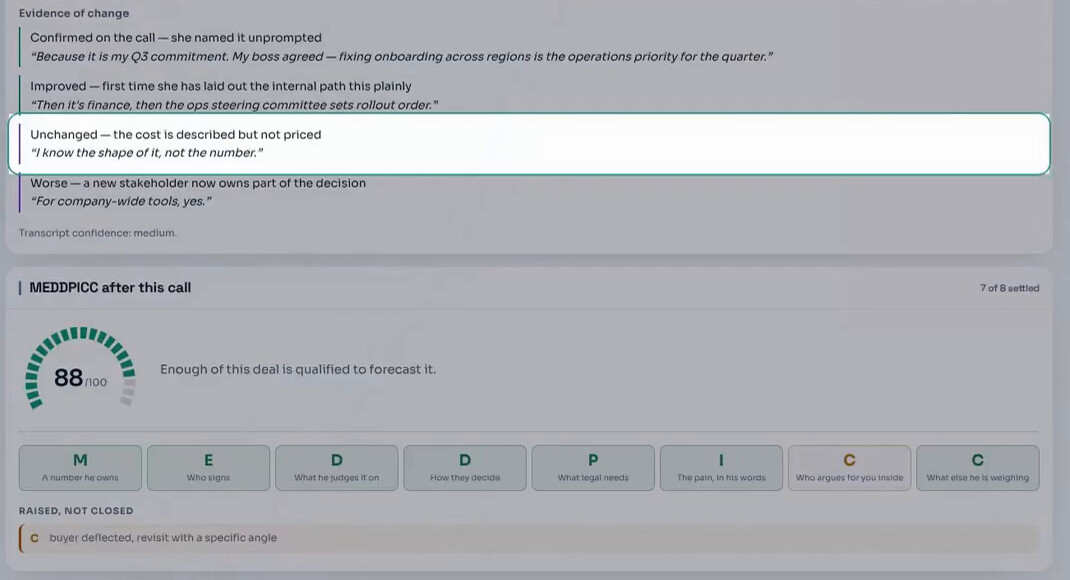
Source: PitchGenius product demo, chapter 6, a frame 20 seconds in, cropped to the evidence and MEDDPICC cards at 1,070 by 580 pixels.
Method and limits: sample data, no customer result.
Where does PitchGenius sit?
Our bet is buyer-aware decision support across the full process. Pre-Call Buyer Intelligence™ builds the Buyer's Blueprint. Live Buyer-State Intelligence™ works the live conversation. The Buyer Readiness Index™ tracks whether the buyer is moving. The Manager Coaching Report turns the record into development.
The differentiator is a continuously updated model of the buyer, the deal, and the current conversation. The same buyer model carries across before, during, and after the call, so three products do not each meet the buyer for the first time.
So which do you buy?
If your primary need is large-scale conversation capture, historical analysis, and organizational visibility into what your teams are saying, evaluate Gong seriously. That is the category’s core job.
If your primary question concerns how AI can help the rep interpret the buyer and decide what to do while the conversation is still happening, evaluate live-copilot platforms against that execution layer specifically.
Plenty of organizations will end up running both categories or a platform that combines them. Either way, the correct decision starts with the job, not the logo.
Compare the cost of each path on pricing, and what real-time coaching costs next to a recording tool sets the other vendors' published prices beside it. If you decide to keep Gong and add a live layer, Gong alternatives for in-call guidance sorts the options by what happens to the contract.
Write down the last deal you lost and the moment it turned. If a recording next week would have shown you that moment, you need conversation intelligence. If you needed help during it, you need live decision support.
Watch the demo to follow one deal through every call.
Frequently asked questions
Is Gong a conversation intelligence platform?
Yes. Conversation intelligence is a core part of Gong’s broader revenue AI platform, alongside deal intelligence and forecasting capabilities.
Does Gong use AI?
Yes. Gong uses conversation analysis, summaries, and AI assistant workflows.
What's the difference between Gong and a live sales copilot?
The precise difference depends on the products compared. Conversation-intelligence platforms grew up around capturing, analyzing, and operationalizing recorded conversations. Live copilots emphasize assistance during the active meeting.
Is PitchGenius a Gong replacement?
Evaluate PitchGenius on its buyer-aware pre-call and live decision-support capabilities. It serves a different moment in the sales process from a one-for-one Gong clone.