
Discovery
Challenger vs. SPIN vs. NEPQ vs. MEDDPICC: Why the Buyer Should Influence How You Sell
Challenger, SPIN, NEPQ, and MEDDPICC solve different jobs, so the right choice depends on the buyer, deal, and moment.
Key takeaways
- 01No method wins alone, since SPIN exposes the problem, Challenger reframes it, NEPQ deepens the buyer's ownership of it and MEDDPICC verifies the deal behind it.
- 02Deal size and committee decide the fit, and Salesmotion places MEDDPICC in enterprise deals above $50K with sales cycles over 90 days.
- 03Sendspark cites Korn Ferry research on teams with more than 75% adoption of one methodology and reads the gains as tracking adoption, not framework choice.
- 04Under pressure a rep cannot reach the method, so a live tool should hand over one concise move at a time that fits the buyer in front of them.
No methodology wins on its own. SPIN exposes the problem, Challenger reframes it, NEPQ deepens the buyer's ownership of it and MEDDPICC verifies the deal behind it, so the buyer in front of you decides which one to use on this call.
Every sales team eventually asks which methodology it should use among Challenger, SPIN, NEPQ, and MEDDPICC.
I ran enablement for a mid-market org, and I learned that this question creates methodology wars. Teams form certified factions, licenses go unused, and reps defend frameworks like hometown teams.
The useful question concerns the approach that fits this buyer, this deal, and this moment. The frameworks are tools, and the buyer in front of you decides which one to use.
What is each one for?
| Method | Job | Strength | Where it fails | Source |
|---|---|---|---|---|
| Challenger | Teach the buyer something new about their business and take control of the sale | Creates urgency by changing how the buyer thinks about the problem | Requires significant enablement investment and reps with deep industry knowledge | Salesmotion, how to choose a sales methodology |
| SPIN | Guide questions through Situation, Problem, Implication and Need-payoff | Develops buyer self-discovery, which Salesmotion says creates stronger commitment than being told what to do | Time-intensive per conversation, so a poor fit for high-volume transactional sales | Salesmotion, how to choose a sales methodology |
| NEPQ | Run a question sequence that lowers defensiveness so the buyer names the problem | Moves a guarded buyer without triggering sales resistance, since the buyer states the problem | A warm, already-committed buyer needs less of the opening NEPQ spends lowering resistance | PitchGenius NEPQ glossary page |
| MEDDPICC | Qualify the deal on eight checks | Forces qualification discipline and gives pipeline reviews a common language | Qualification-heavy, so it tells you whether to pursue a deal and does not prescribe how to advance it | Salesmotion, how to choose a sales methodology |
Source: the Challenger, SPIN and MEDDPICC rows summarize the vendor pages linked in each row, such as Salesmotion, fetched October 1, 2026, and the NEPQ row summarizes our own glossary page because no neutral third-party page was fetched for it. Strengths and failure modes are the cited vendors' wording, shortened.
Method and limits: the four rows sort the methods by the job each does. Salesmotion and Sendspark both sell software that works with these frameworks, and neither is a study of win rates.
Described this way, the frameworks stop sounding like competitors. A single strong seller can run all four in one call.
Which method fits which deal?
Deal size, committee size and cycle length decide how much qualification a deal needs. Salesmotion places MEDDIC and MEDDPICC in "enterprise B2B with deal sizes above $50K, complex buying committees, and sales cycles exceeding 90 days" (Salesmotion, fetched October 1, 2026). Below that size, a lighter discovery method does the job and qualification can live in a single field.
Rackham built SPIN from observation. Wikipedia summarizes the project as "a team of 30 researchers who studied 35,000 sales calls in over 20 countries" across 12 years (Wikipedia, Neil Rackham, fetched October 1, 2026). That is the research base behind SPIN's question types.
AskElephant argues that MEDDIC leads for AI-assisted teams because its elements "map directly to CRM fields that AI can capture and update automatically after every call" (AskElephant, best sales methodology for the AI age, updated March 5, 2026, fetched October 1, 2026). AskElephant sells that automation, so the claim describes data capture, and it says nothing about which method wins a deal.
Does consistent use matter more than the choice?
Sendspark cites Korn Ferry research that teams with more than 75% adoption of one methodology see "+21% quota attainment, +15% win rates, and +6% revenue attainment" against teams without a consistent framework (Sendspark, fetched October 1, 2026). Sendspark's own reading is that the gains "track adoption, not framework choice."
That supports a primary method per team. It does not say a rep must run only that method on every buyer, and the next section shows where a rep adapts delivery.
Two CFOs, one job title
Two CFOs with the same job title show why the buyer should drive the approach.
One CFO opens the meeting with "Give me the numbers. I don't want a long presentation."
Another CFO, with the same title and in the same industry, says "Walk me through how customers experienced the transition."
The first wants evidence and velocity. The second wants narrative and reassurance. A story would disrespect the first CFO’s time, while a spreadsheet would do the same to the second. A seller can keep a consistent process while adapting its delivery to the person receiving it.
What does it look like when a tool applies the method for the rep?
PitchGenius matches one of four techniques, SPIN, NEPQ, Challenger or a hybrid, to each buyer before the call. It reads what is known about the buyer, where the deal sits and how this buyer communicates, then scores each technique. When the evidence is thin, it steers toward the hybrid instead of a confident single pick.
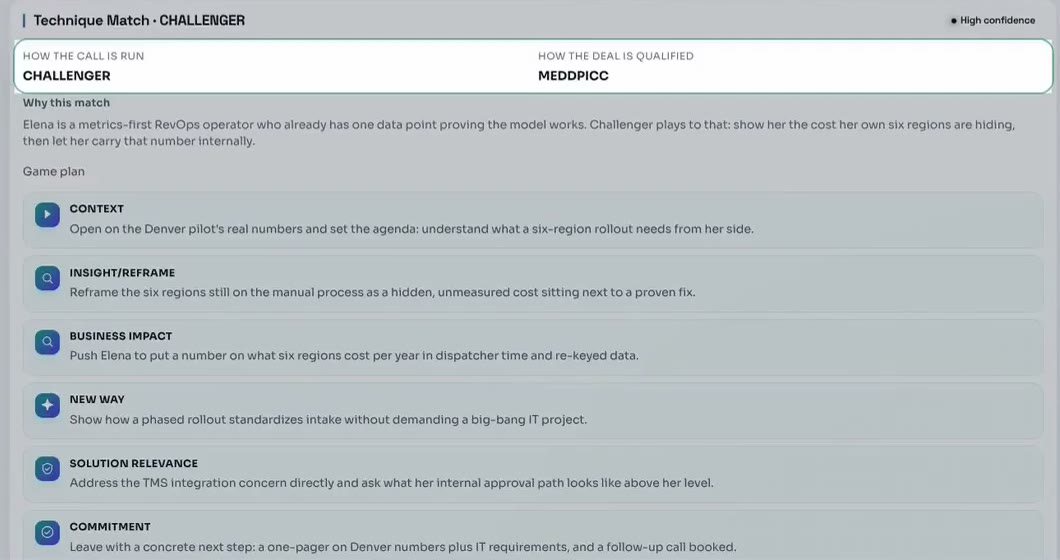
Source: PitchGenius product demo, chapter 3, the frame at 10 seconds of the recording, cropped from the 1920 by 1080 capture to 1060 by 560 pixels.
Method and limits: sample data, no customer result.
The match gives the rep a game plan in the technique's own steps. The Insight/Reframe step reads "Reframe the six regions still on the manual process as a hidden, unmeasured cost sitting next to a proven fix." A label like "use Challenger" gives the rep nothing to say, and that sentence gives the rep the next thing to say.
Why does methodology disappear under pressure?
In the middle of a call a rep has no time to search "what did chapter four of the training say about this?", so the method has to arrive as one concrete move. The overlay keeps the methodology out of sight and hands the rep one move at a time, which real-time coaching without cognitive overload explains in detail. Live Buyer-State Intelligence fills the eight MEDDPICC letters in a strip as the buyer's own words give evidence for each.
How do you use all four on one deal?
Pick a primary that fits your sales motion, deal complexity, buying committee and sales cycle. Then teach reps how to adapt the approach without abandoning the process.
Discovery for multi-stakeholder enterprise deals assigns each method to a conversation in an enterprise deal. The pre-call buyer plan shows where the match comes from, and the Buyer's Blueprint holds the buyer read the match starts from. Methodology-heavy teams that compare vendors can read how PitchGenius sits next to Gong on live guidance.
The best sellers I managed had a process they could defend in a forecast call and the judgment to flex delivery buyer by buyer.
Traditional enablement taught methodology before the conversation. Conversation intelligence reviewed its application afterward. Live AI adds a third option, applying the methodology while the conversation is unfolding.
Pick one open deal and write the single sentence the buyer has said about how they decide. Choose the method that fits that sentence before the next call, and drop the one your team defaults to.
Watch the demo to follow one deal through every call.
Frequently asked questions
Is Challenger better than SPIN selling?
Neither is universally better. Challenger focuses on commercial reframing and SPIN on disciplined discovery, and each shines in different contexts.
Is MEDDPICC a sales methodology?
It is better understood as a qualification and opportunity-management framework than a conversational methodology. It tells you whether the deal is real, and it does not tell you what to say next.
Can sales teams use multiple methodologies?
Yes. Organizations can keep a primary selling process while drawing on complementary frameworks for discovery, reframing and qualification.
How does PitchGenius use sales methodologies?
PitchGenius AI matches Challenger, SPIN, NEPQ or a hybrid to the buyer before the call and turns the match into specific moves in the technique's own steps. When a deal runs on MEDDPICC, the live strip fills each letter as the buyer's words give evidence for it.
Which method should a new sales team start with?
Start with the method that matches your deal size and committee. Salesmotion places MEDDPICC with deals above $50K and long cycles, and a lighter discovery method fits smaller deals.