
Live coaching
Real-Time Sales Coaching Without Cognitive Overload
Live sales AI helps when a rep can absorb it, so a useful copilot stays quiet until a cue deserves attention.
Key takeaways
- 01A live copilot earns trust by putting one or two cues in front of the rep and leaving everything else it knows off the screen.
- 02A 2025 study of 34 financial professionals found that extraneous load had roughly three times the negative association of intrinsic load.
- 03PitchGenius is silent by default and interrupts only when its classification clears a confidence floor and a cooldown.
- 04You can test any copilot on one live call by noting every moment it pulled your eyes off the buyer, because each one is a cue it should have held back.
A live copilot earns trust by putting one or two cues in front of the rep and leaving everything else it knows off the screen. A study of AI-assisted knowledge work found that the load from how help is delivered hurt quality roughly three times as much as the difficulty of the task.
Handing a salesperson five dashboards to read while asking for eye contact with a buyer creates an impossible workload. Poorly designed live AI creates that workload mid-call and then presents the feature list as a strength.
What is cognitive load in a sales call?
Cognitive load is the mental effort a task demands, and Cognitive Load Theory splits it in two. Intrinsic load comes from the difficulty of the task itself, and extraneous load comes from how the help is delivered. A buyer's objection carries intrinsic load. A pop-up that asks the rep to read a paragraph carries extraneous load.
Trellus, which sells real-time coaching software, puts the intrinsic side in one line: reps "must recall product positioning, pricing tiers, competitor differentiators, and objection responses instantly. That cognitive load is enormous" (Trellus, February 19, 2026, fetched October 1, 2026). Ringover lists "Reduced cognitive load" as a benefit of its AIRO Coach, which "surfaces exactly what the rep needs at the right moment" (Ringover, AI sales coach, fetched October 1, 2026). Neither page publishes a measurement of load, so both pages state a goal.
How much can a rep hold at once?
During a meeting, the rep processes the buyer's words and tone, the previous three conversations, product knowledge, pricing, methodology, open objections, stakeholder politics, the next question and the answer to the last one. That list has ten items.
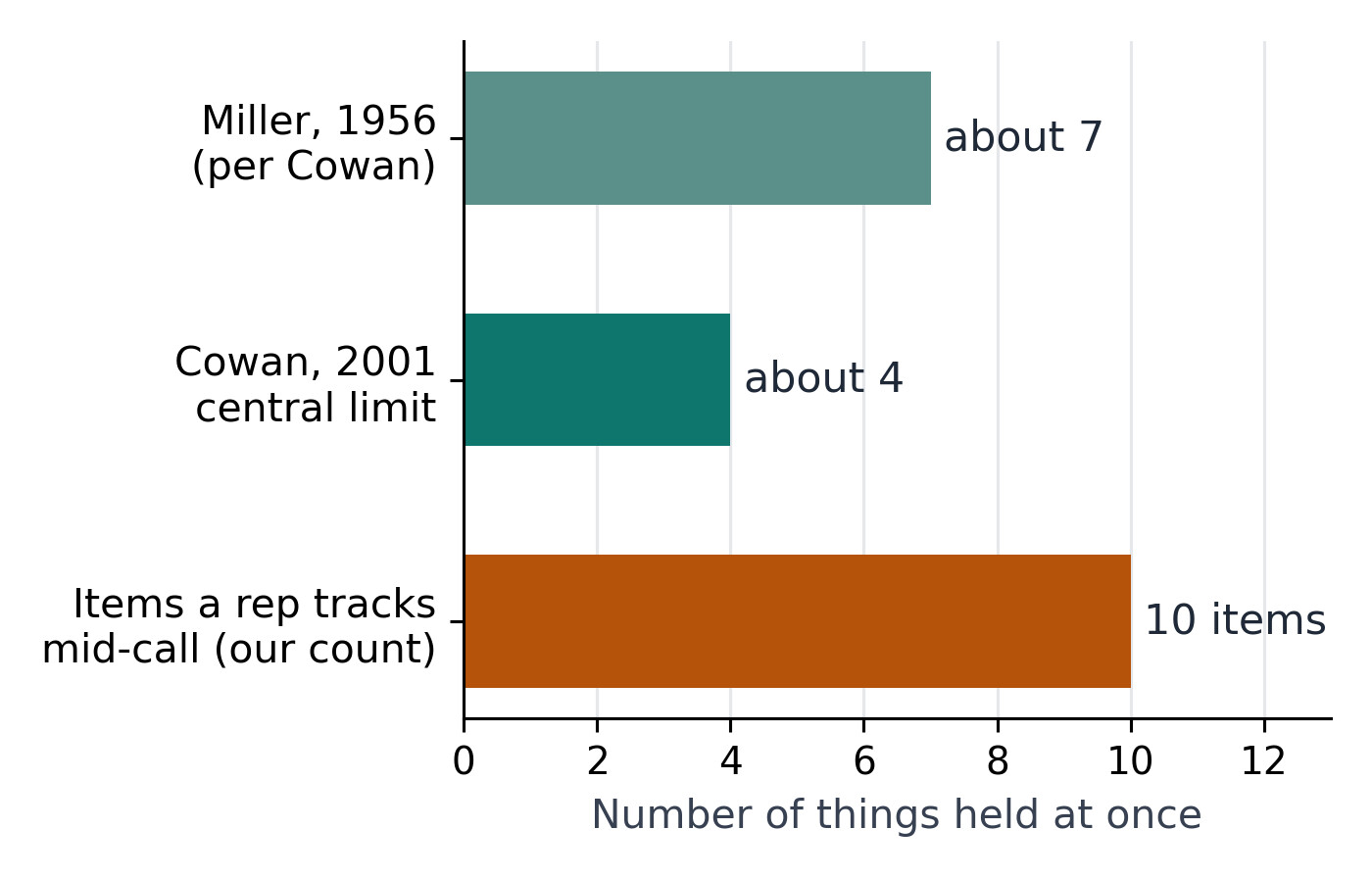
Source: Cowan, The magical number 4 in short-term memory, Behavioral and Brain Sciences, 2001, abstract fetched October 1, 2026. The abstract says Miller "summarized evidence that people can remember about seven chunks" and that "a single, central capacity limit averaging about four chunks is implicated."
Method and limits: the two memory bars come from the abstract and the ten-item bar counts the items in the paragraph above. Chunks and items are different units, so the chart shows the size of the gap and measures no rep.
Cowan's central limit sits at about four chunks, and a rep's mid-call list is longer than that. Practice packs several items into one chunk, which is why a veteran copes. A new cue is one more item for everyone.
What does research say about AI that interrupts?
A 2025 study titled "Precision Proactivity" tested this directly with 34 financial professionals who completed a valuation task with GPT-4o. Across 1,178 participant-subtask observations, "AI-generated content usage is positively associated with quality, while extraneous load shows the largest negative association, roughly three times that of intrinsic load." The strongest predictor of decline was "model-initiated task switching" (Lepine, Kim, Mishkin and Beane, arXiv 2505.10742, last revised March 7, 2026, fetched October 1, 2026).
Three readings follow for a live coach.
- The help is worth having, since using the AI's content raised quality.
- The delivery is where the damage happens, so a cue that makes the rep switch tasks costs more than the call's own difficulty.
- Less experienced people "face larger penalties and derive greater marginal gains," so new reps are the ones who gain the most and are hurt the most by a noisy tool.
The limits matter. The participants were financial professionals typing to a chatbot on a valuation task, and the load estimates came from transcripts. A spoken sales call is a different setting, and no study we found measures a live sales overlay. The study supports a design principle, and it does not prove a number for sales.
What should a live copilot leave off the screen?
A capable live copilot can detect dozens of things in one call, and the rep needs to see one or two of them. What the assistant leaves off the screen is part of its quality.
Showing everything is the easy engineering. Showing one cue at the right moment is harder, and it determines whether the product supports a decision or steals attention. A rep who sees a flashing list of Talk ratio 54%. Competitor detected. Sentiment changed. MEDDPICC gap. learns to stop looking, and the underlying problem remains.
How does PitchGenius decide when to speak?
Live Buyer-State Intelligence™ is silent by default. It analyzes the conversation continuously and speaks when the buyer's signal changes. Each turn is classified against the methodology's order and the deal's qualification framework first, and a card interrupts the rep only when that classification clears a confidence floor and a cooldown.
The overlay is compact and shows one suggestion at a time, revealed word by word, with a "why" disclosure beside it. The model can decline to speak, and when it does, the "thinking" cue disappears so the overlay never dangles a suggestion that is not coming.
A cue is a short prompt, and the reason sits one click away.
Explore the risk.
Don't answer yet. Ask what changed.
Confirm who owns approval.
A rep takes those in at a glance with eyes on the buyer. Each cue carries five layers on the learn page, the signal, the context, the evidence, the meaning and the move, so the rep can argue with it. "Change approach" tells the rep nothing. "Buyer shifted from implementation questions to uncertainty about internal approval. Explore stakeholder risk" gives the rep something to act on or reject.
PitchGenius has not published a latency figure or a measurement of cognitive load for the overlay, and its llms.txt says so. The design follows the principle above, and it has no number of its own to cite yet.
Does a cue teach the rep anything?
Repeated explained cues are meant to teach the pattern. Once a rep hears conditional language themselves and explores the risk unprompted, the cue has done its job. We have no measurement that this carries over when the tool is off, so treat it as the goal of the design and test it on your own team.
The outcome to aim for is a rep who says "my copilot helped me notice things I didn't used to notice," and who keeps noticing them with the overlay off.
How do you test a copilot before you buy it?
Run it on one live call and note every moment it pulled your eyes off the buyer. Each of those is a cue the tool should have held back. Then count how many cues you used. Roll out an AI sales coach without reps feeling watched turns that count into a rollout measure, which PitchGenius calls follow-through. To see the live approach next to another overlay product, read PitchGenius against Convo. What counts as a signal worth a cue is listed in seven signals in how a buyer talks, and the future of sales AI argues for the human-led design behind it.
The full quiet-by-default design sits inside the platform, and everything the system knows and held back waits for the post-call report.
Watch the demo to follow one deal through every call.
Frequently asked questions
What is cognitive overload in sales technology?
When the information competing for a salesperson's attention interferes with their ability to listen, think and respond during the conversation. Cognitive Load Theory calls the delivery part extraneous load.
What is quiet-by-default AI?
An interaction model where the AI keeps analyzing but surfaces guidance only when importance or confidence conditions justify an interruption.
Should an AI sales copilot constantly give suggestions?
No. A 2025 study of AI-assisted work found that model-initiated task switching was the strongest predictor of decline, and excessive prompts cost more attention than they return.
How does the live copilot reduce screen clutter?
One suggestion at a time, a compact overlay, a short explained cue, and a cooldown plus a confidence floor before any card interrupts. The prompts are designed to be read at a glance.
Related posts