
Live coaching
Why Post-Call Sales Coaching Is Too Late for the Moments That Decide the Call
Post-call coaching develops future conversations, while live decision support can still change the moments that decide a deal.
Key takeaways
- 01Post-call coaching develops the next conversation, while live decision support helps the rep during the current one, so the two answer different problems.
- 02Two vendor guides pick by bottleneck, starting with real-time coaching when live call execution is the issue and with post-call review when coaching priorities are unclear.
- 03ViraCue reports from six of its own customer teams that rep independence dropped by month four when real-time coaching ran with no practice layer, which is a risk to test and not a proven result.
- 04A cue that names what the buyer appears to be doing teaches judgment each time, and an exact script teaches obedience.
Post-call coaching develops the next conversation, while live decision support is built to help during the current one.
A buyer leans back and says "We built something similar internally last year."
The rep has five options and about four seconds. They can defend the product, ask what the internal project solved, challenge the assumption, ask why the buyer is looking at outside tools if the internal system worked, or move on.
The right choice depends on what the buyer meant by it. A manager reviewing the recording tomorrow can spot the missed opening immediately. The recording is very good at that. The opening existed yesterday, so tomorrow it is a coaching anecdote rather than a save.
Gong Labs analyzed 326K sales calls that lasted at least 10 minutes and found sellers talked a little more in the deals they lost.
| Outcome | Seller talk time |
|---|---|
| Closed-won deals | 57% |
| Lost deals | 62% |
Source: Gong Labs, talk-to-listen ratio analysis, updated March 20, 2025, fetched September 30, 2026.
Method and limits: Gong analyzed 326K sales calls of at least 10 minutes between reps and potential customers, in 2025. Of the gap between won and lost deals Gong says, "But that difference isn't massive." The page states no limitations and no test of cause, so read the figure as an association.
Post-call coaching is still needed. It just cannot help a rep who is stuck in the middle of the call.
Two different problems
Post-call coaching develops how this salesperson can perform better next time.
Live decision support helps this salesperson navigate what is happening right now.
A modern sales organization needs both. They answer different questions. Post-call work develops the seller, and live support helps the seller handle the active moment.
Which one do you start with?
Two vendor guides frame the choice by the bottleneck. ViraCue's guide says to start with real-time coaching when the primary issue is live call execution, with post-call review when coaching priorities are unclear, and with both when scaling a team quickly (ViraCue, published April 10, 2026, fetched October 1, 2026). Spiky defines the other side of the line as coaching that helps reps "learn after the fact", which "is valuable for long-term improvement" (Spiky, fetched October 1, 2026). Read as a decision, it comes to this.
| What you see on your calls | Start with | Why |
|---|---|---|
| Reps know the method and lose it in pressure moments such as a pricing push | Live guidance | The fix has to arrive inside the call |
| Managers disagree about what to coach | Post-call review | The disagreement is about evidence, and a recording settles it |
| One rep repeats the same miss on every call | Post-call review, then a live cue for that miss | The pattern shows after the call, and the cue is the correction |
| New hires ramp slowly | Both | Review finds the gaps and the live cue reinforces the fix |
ViraCue also reports, from six teams in its own customer base that deployed real-time coaching with no practice layer, that objection handling improved in the first 60 days and rep independence dropped by month four, with reps waiting for prompts. It is one vendor's customer data with no method published, so treat it as a risk to test. Its question to ask any live-coaching vendor is what happens to rep performance on calls where the system is not running.
For PitchGenius the design answer is that a cue names the signal and the reason, so the rep learns to see it, and the record after the call shows which cues were used. Whether that prevents prompt dependence on your team is something to measure on your own calls, since no result is published.
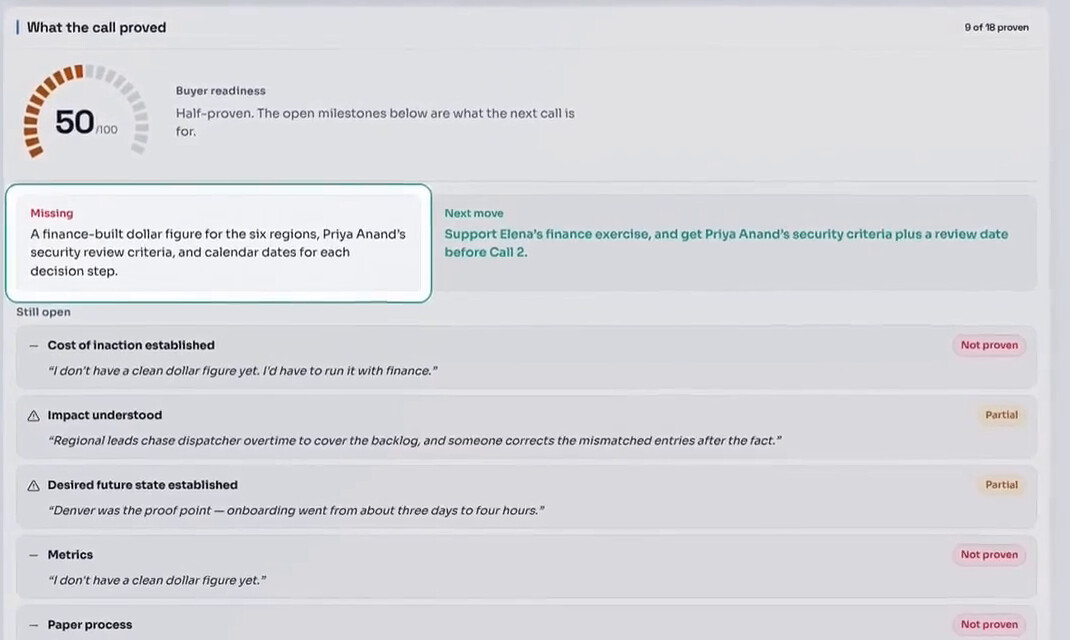
Source: PitchGenius product demo, chapter 6, a frame 34 seconds in, cropped to the What the call proved card at 1,070 by 640 pixels.
Method and limits: sample data, no customer result.
Knowing and access are different
Eight years of managing reps taught me that knowing how to sell and accessing that knowledge under pressure are different skills with different failure modes.
The rep knows Challenger cold, completed SPIN training, can recite MEDDPICC in their sleep, and has memorized the battlecards. Then the buyer introduces a hairy objection and the rep defaults to habit. They explain more, listen less, and fill the silence with features.
This is an execution problem. More training does not solve it by itself. In that moment, the rep needs retrieval. The reminder must arrive at the right time and remain small enough to use without abandoning the conversation.
The useful format is a line about the next move. Don't defend yet. Ask what failed internally.
Can managers sit on every call?
The best sales managers I worked with recognized inflection points almost instantly. You could watch them hear a call go sideways before the rep felt it.
One of them managed eleven sellers. Each rep ran five or six conversations a day. The math never allowed her attention into the room. Her coaching was excellent and always arrived after the moment it described.
Real-time AI supports the manager without replacing her. It scales access to the situational reminders a strong manager would whisper if she could be there. Those reminders identify what is shifting, what is being missed, and what to ask next.
Post-call is where patterns live
After the meeting, different questions become answerable. The team can see where readiness moved, what this rep repeatedly misses, whether they push too early, whether they explored the buyer’s concern, whether they mistook politeness for commitment, and whether the next step was actual or hopeful.
Across many calls, those patterns become coaching material for skill development. That is why PitchGenius ships a Manager Coaching Report alongside live buyer-state guidance. Each addresses a different part of the work.
Live guidance helps the conversation, while post-call analysis develops the salesperson.
The loop that works
Coaching works best when the live moment and the work after it use the same evidence.
Before. Prepare for the buyer, not just the account.
During. Recognize what is changing while it can still be answered.
Immediately after. Capture evidence, commitments, and what happened.
Across calls. Identify the patterns.
In coaching. Develop judgment with real examples.
Next call. Apply the learning.
A quarterly training event built around a slide deck cannot provide that loop.
The failure mode to design against
One legitimate worry about real-time guidance concerns scripts. If AI tells sellers exactly what to say, reps can stop thinking and lose their judgment.
That would be bad product design, and one test tells the two apart. "Buyer appears uncertain about implementation risk" teaches the rep something each time it appears. "Read this 42-word script exactly" teaches obedience without building judgment.
PitchGenius cues name the signal and leave the decision with the seller.
The full before, during, after loop is mapped on how it works.
Which live tools exist and what each one's cue is made from is in the best real-time sales coaching software, and what is an AI sales copilot defines the live side. Open the last call you reviewed after the fact and mark the second where the buyer's tone changed. Write down what the rep needed in that second to answer it, and ask whether anything could have supplied it.
Watch the demo to follow one deal through every call.
Frequently asked questions
What is real-time sales coaching?
Guidance or information delivered to a salesperson while the customer conversation is occurring.
Is post-call coaching still important?
Yes. Post-call coaching supports pattern recognition, manager feedback, and long-term skill development. It cannot reach the moment it describes.
What's the difference between live guidance and sales coaching?
Live guidance supports execution in a specific moment. Coaching develops capability across repeated situations.
Can AI replace a sales manager?
No. AI can scale certain forms of observation and reminder. Leadership, accountability, development, and contextual judgment stay human. A manager who knows the rep, the deal, and the politics has no software substitute.