
Live coaching
What Is an AI Sales Copilot? Help During the Call, Not After It
An AI sales copilot interprets a conversation while it is happening and helps the rep act before the useful moment has passed.
Key takeaways
- 01An AI sales copilot interprets a live conversation and helps while the rep can still act, and the word live separates it from recorders and conversation intelligence.
- 02Published copilot definitions range from recommendation engines to assistants for the whole sales process, so sorting tools by the moment each one acts is the useful test.
- 03A useful in-call assistant answers four questions in order, what just happened, what it might mean, what matters most right now and what the move is.
- 04More output makes a live tool less useful, so the AI notices and suggests while the human decides.
An AI sales copilot interprets a live sales conversation and helps while the rep can still act, which separates it from recorders and conversation intelligence that work after the call.
Mid-call, a buyer says "I don't think our CFO is going to approve another platform this quarter."
The rep has a few seconds to read it. It could be a budget objection. An authority problem. Weak urgency. Implementation fear. Polite disengagement. Or it could be the reading that saves deals: an invitation to help build the business case.
Six interpretations can fit one moment, and there is no rewind. Tomorrow’s transcript can explain what happened. It cannot change what happens next.
That gap is what an AI sales copilot is built for.
The short answer
An AI sales copilot is software that interprets a live sales conversation and provides help while the salesperson can still act on it. It can flag an objection, recognize a shift in buyer readiness, suggest a question, surface missing information, and recommend the next move.
The defining word is live. Recorders, transcribers, conversation intelligence, and meeting notetakers work after the moment has passed.
Meeting intelligence got there first
The first generation of conversational sales tech solved a real problem. Sales conversations used to disappear when meetings ended. Recording platforms changed that. Calls became searchable. Managers could review them. Coaching could cite evidence instead of vibes. CRM notes wrote themselves.
The most expensive decisions in a deal still happen during the conversation, and a rep cannot rewind a prospect.
Which kinds of AI sales copilot exist?
The word covers more than live help. Three published definitions, each from the vendor's own page as of October 1, 2026, show the range. Revenue.io's glossary describes a tool that "offers personalized recommendations, predicts customer behavior, and automates tasks". Amplemarket calls it an assistant that works "throughout the sales process" and says it "automates routine tasks". Mixmax describes one that works in your inbox and analyzes "real-time engagement signals" to advise on "the next five minutes", such as a prospect reopening a proposal.
Sorted by the moment each one acts, they are different tools.
| Kind | Moment it acts | What it reads | Example |
|---|---|---|---|
| Live copilot | During the call | The conversation as it happens | PitchGenius, which also profiles the buyer before the call |
| Inbox copilot | Between calls | Email opens, replies and proposal views | Mixmax |
| Prospecting and workflow copilot | Before outreach, across the workflow | Lead data, past interactions and purchase history | Amplemarket and Revenue.io's glossary |
The three pages above describe the second and third rows. This page is about the first, because a rep cannot rewind a prospect, and the other two do not reach that moment.
What does a live copilot answer?
A useful in-call assistant handles four questions in order.
- What just happened? What signal appeared in the last thirty seconds?
- What might it mean? Interpret the signal in the context of this deal.
- What matters most right now? Choose among exploring, challenging, clarifying, reassuring, or staying quiet.
- What's the move? Give the rep one concise next step.
This is decision support. Transcription supports replay, while a copilot supports action during the conversation.
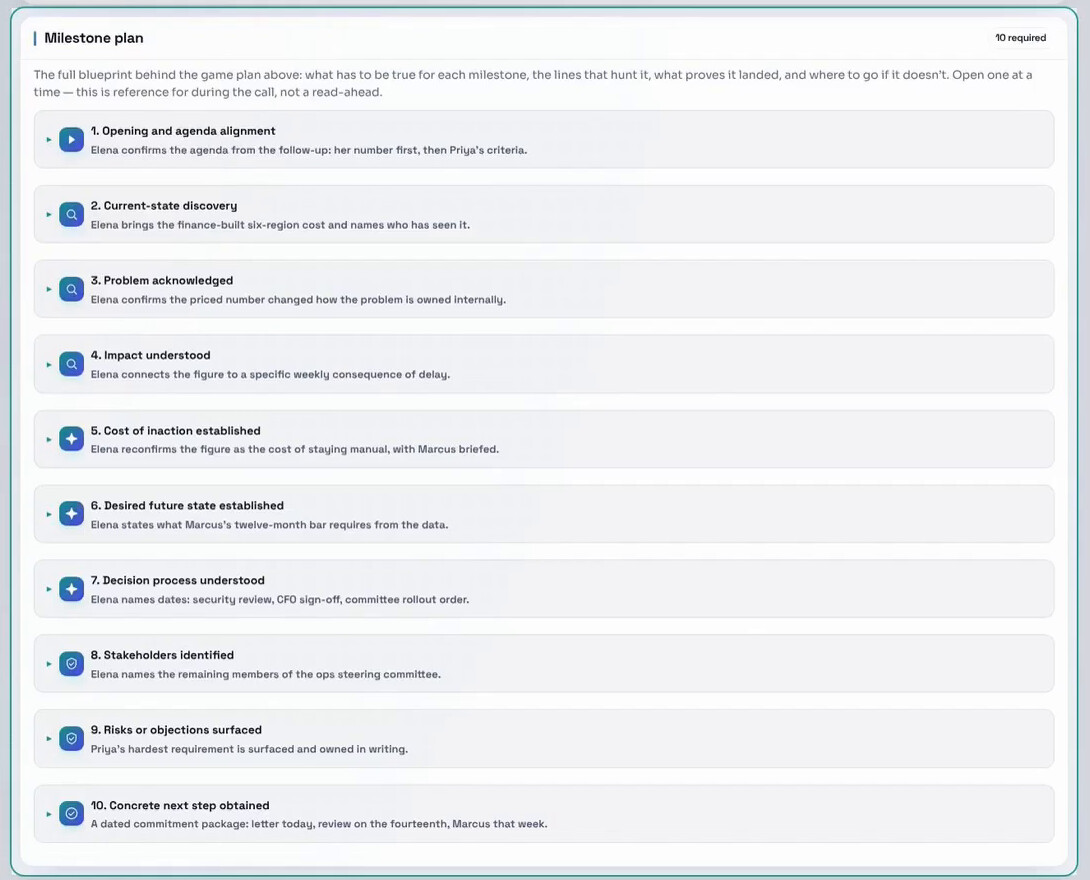
Source: PitchGenius product demo, chapter 12, a frame 20 seconds in, cropped to the Milestone plan card at 1,090 by 880 pixels.
Method and limits: sample data, no customer result.
Can more output make a rep worse?
During a live conversation, more output reduces usefulness.
A seller is already listening, thinking, remembering account context, watching reactions, planning the next question, and deciding what not to say. Five flashing alerts add a sixth thing to juggle.
A live copilot has to know when not to interrupt.
That is why we built Live Buyer-State Intelligence™ quiet by default. It stays silent until there is a meaningful reason to assist. When it speaks, the cue can be absorbed in a glance, such as explore the concern, do not re-argue the objection, let the buyer continue, or risk appears to be increasing. The rep stays present with another human being and keeps the dashboard peripheral.
Copilot, note taker, or conversation intelligence?
The labels overlap, so sort them by the moment of value.
- AI note taker answers what was said?
- Conversation intelligence answers what should we learn from all our calls? It works with transcripts, themes, deal signals, and coaching analytics.
- An AI sales copilot answers what should I pay attention to right now?
Some platforms mix all three. Compare them by whether and how well they help before, during, or after the call.
From keywords to buyer interpretation
Basic live assistance recognizes phrases such as "competitor," "pricing," "budget," and "security." That is useful up to a point.
A human conversation carries more information than keywords. It includes hesitation, confidence, willingness, perceived risk, stakeholder dynamics, and shifts in commitment. The useful step is from one reading to the next.
"The buyer mentioned price."
"Price may not be the real objection. Their language suggests implementation risk is preventing commitment."
Judgment stays human
A model forms probabilistic interpretations from evidence, and the rep should see them that way. The copilot notices and suggests, and the rep decides.
Over time, seeing why a moment matters helps a seller recognize it unaided.
The rest of what a live copilot does end to end lives on the platform overview. Which live tools exist, and what each one's cue is made from, is in the best real-time sales coaching software, and Gong versus live AI sales copilots covers the recorder side of the line.
When you trial a copilot, watch one live call and ask of every cue it showed whether the rep could still use it before the moment passed.
Watch the demo to follow one deal through every call.
Frequently asked questions
What does an AI sales copilot do?
It listens to or analyzes an active sales conversation and provides relevant information or suggested actions while the meeting is still occurring.
Is an AI sales copilot the same as a meeting recorder?
No. A recorder captures the conversation. A live copilot helps during it.
Can an AI sales copilot handle objections?
Some systems recognize objection-related language and surface prompts or information. The rep handles the interpretation and delivery.
Does an AI sales copilot replace sales coaching?
No. Live assistance supports execution in a moment, while coaching develops capability across months. They are different systems.
What is Live Buyer-State Intelligence?
Live Buyer-State Intelligence™ is PitchGenius's live sales copilot. It interprets buyer and deal signals and provides low-cognitive-load guidance during sales conversations.